Formation is a black box. Listen inside it.
Formation is one of the slowest and costliest steps in making a cell. Passive acoustic-emission sensors on your formation equipment capture activity inside each cell, classified by our AI in real time, so formation can be tuned for less time, less scrap and anomalous cells identified as they form.
Why formation is hard to improve.
Slow and expensive
Formation ties up equipment, energy and floor space for days or weeks. It has been a very time-consuming, iterative process, until now.
Sensitive to changes
Every small tweak in cell chemistry, format or formation protocol can result in changes in how a cell forms.
Limited information
Formation is still a black box: there is currently no effective way to observe a cell's internal changes during formation in real time.
A signal that follows the process.
Activity inside a cell during formation and ageing produces acoustic emissions. Synchronised with your electrochemical data, they give you a second record of each cell in real time: when activity rises, when it settles, and how one cell compares with another. Variation that the electrochemical data smooths over shows up as a difference you can see.
The visuals on this page are illustrative. They show how the monitoring works, not measured data from a particular cell.
Compare cells
Build a reference for your cell, then investigate activity that differs across a batch or between formation runs.
Compare process variants
See how formation activities change under new chemistries, formats and protocols, alongside your electrochemical data.
Act on it
Spot the cells that warrant a closer look, and fine-tune the protocol based on observable and verifiable evidence.
Fitted to your equipment. Configured around your cell.
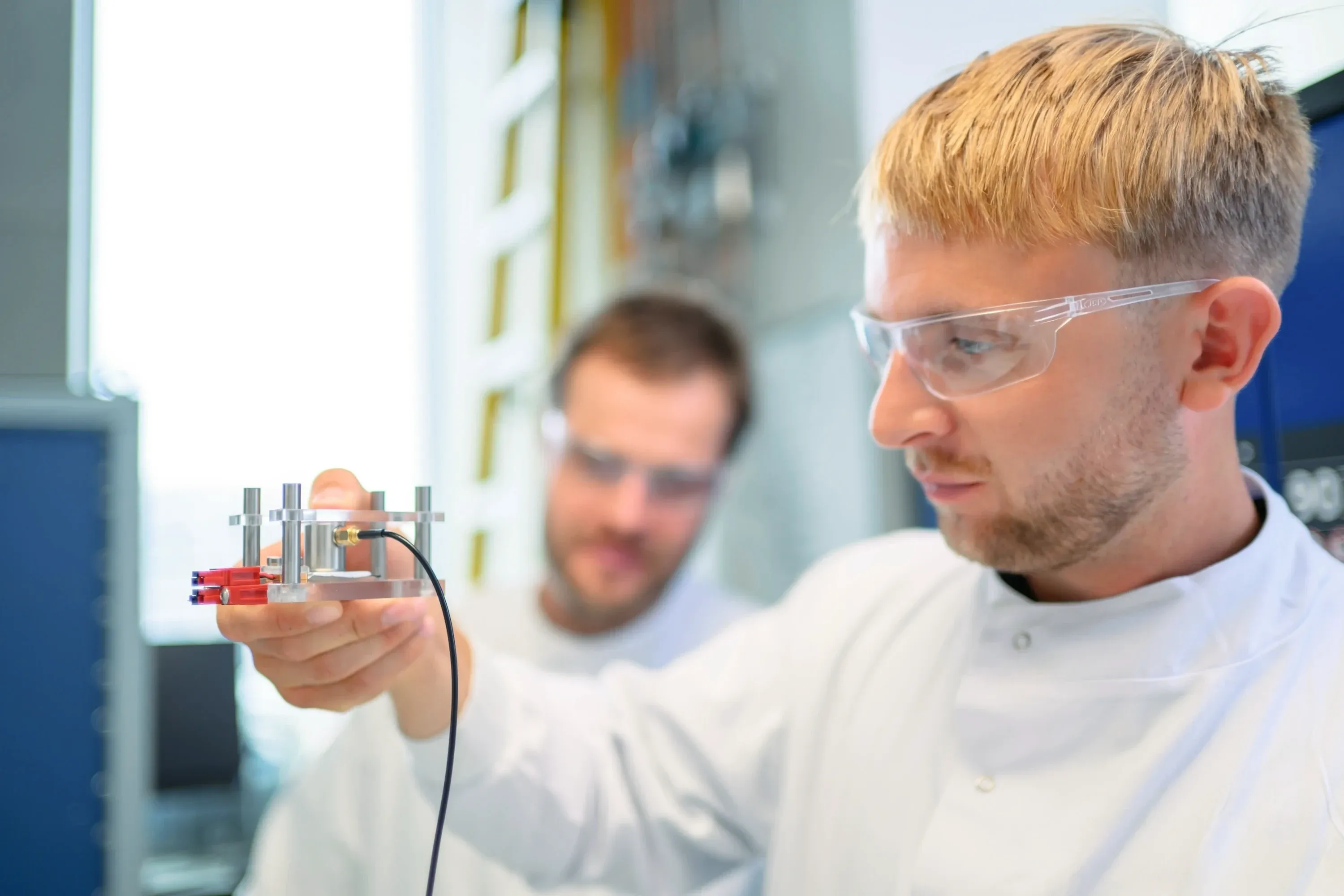
Plug & play integration
Retrofit onto existing formation equipment with minimal disruption to production.
Bespoke sensor fixtures
We create bespoke sensor fixtures tailored to your cell, equipment and safety requirements.
Passive and non-invasive
The sensor mounts externally and just listens, without modifying the cell or interfering with its operation.
What the evidence shows so far.
The method is grounded in published research on acoustic emission during formation and ageing, including work on lithium-ion, sodium-ion, silicon-anode and solid-state cells across cylindrical, pouch and prismatic formats. Our early industrial work has been in laboratory and pilot-line settings, and production-line deployment is the next step.
Our aim is to track when the key stages of formation complete for each cell, in real time, so the protocol can be tuned to what the cell is doing: shorter formation and less scrap.
Read the researchHow a formation demo starts.
Most customers start with a formation demo on one line or in the R&D laboratory.
A technical call
A short call with your formation, process or quality team to understand your equipment, the cell and the question you most want answered.
A written scope
What we will measure, on which cells, how long it takes, what a useful result looks like and what we need from you.
Sensors on your equipment
We configure and test sensors on your formation equipment, in your R&D laboratory or on a single pilot line, and run the first cycles under your existing protocol.
What you get
Monitoring during the agreed runs, then a synchronised record, the classified hits and findings on which cells differ and why.
Questions we're usually asked.
What data do we collect?
We collect acoustic emission data synchronised with available cell and process data, including voltage, current, temperature and pressure, to provide a richer view of each formation and ageing cycle.
How is our data stored?
Your data can be processed and stored entirely on-premise, giving you full control over access. Secure cloud-based options are also available for hosted deployments.
How quickly will we see results?
Initial insights can emerge from the first calibration runs. As more data is collected, AcouBatt can establish robust baselines, identify cell-to-cell variation and support measurable improvements to formation and quality control.
Can we start small?
Yes. AcouBatt can begin with a focused study in your R&D laboratory or on a single pilot line, before scaling into wider production.
Request a demo.
The cell format, the formation equipment and the question you're trying to answer are enough to start. We'll tell you whether acoustic-emission monitoring is likely to help and what a demo would involve.
Request a demo