A signal from inside the cell, captured from the outside.
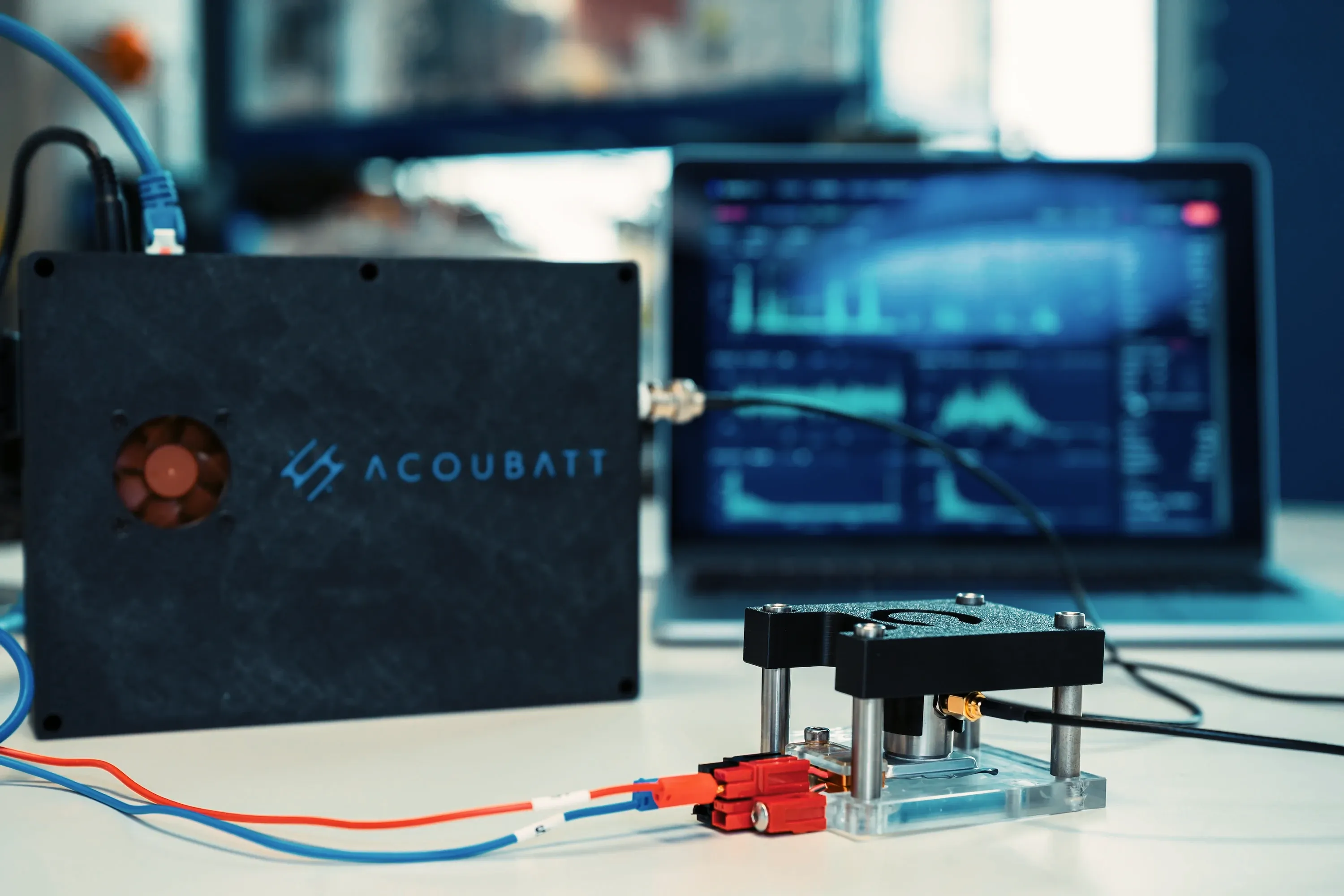
Passive sensors on the outside of a cell or its fixture capture its acoustic emissions. Our AI classifies each hit in real time as another signal, synchronised with your electrochemical and conventional data, giving you an additional layer of intelligence.
What we mean by acoustic emission.
Acoustic emission is the brief elastic wave released when something changes inside a material. In a battery, that can be physical or electrochemical activity as the cell forms and ages. The waves travel through the cell and its fixture to the surface, where a sensor on the outside picks them up while the cell is in use.
It is not audible sound, and it is not the ultrasonic pulse used in imaging. Nothing is sent into the cell. We only listen.
What makes a cell emit.
Research has linked acoustic emission in batteries to a set of physical and electrochemical processes. They happen at different stages of a cell's life, and most are not directly captured by the electrochemistry data while they are happening.
Gas evolution
Gas forming inside the cell, during the first cycles and again when the electrolyte breaks down later in life.
Particle cracking
Active-material particles fracturing under the stress of charge and discharge.
Layer separation
Delamination between electrode layers as the cell expands, contracts and ages.
Lithium plating
Metal depositing on the anode surface, which research has associated with acoustic activity under tested conditions.
Noise separated
The raw signal from the sensor, before any hit is recorded.
The span above the threshold is recorded as one hit.
Acoustic data is collected as it happens.
Operational noise characterised in the setup, then separated.
The visuals on this page are illustrative. They show how the monitoring works, not measured data from a particular cell.
Every cell has a voice.
Four short steps to understand what the cells are trying to tell you.
Raw signal
Illustration. A quiet raw signal runs across the window while a cell sits in a test fixture beside it with a small sensor against its face. The raw signal from the sensor, before any hit is recorded.
A sensor on the outside
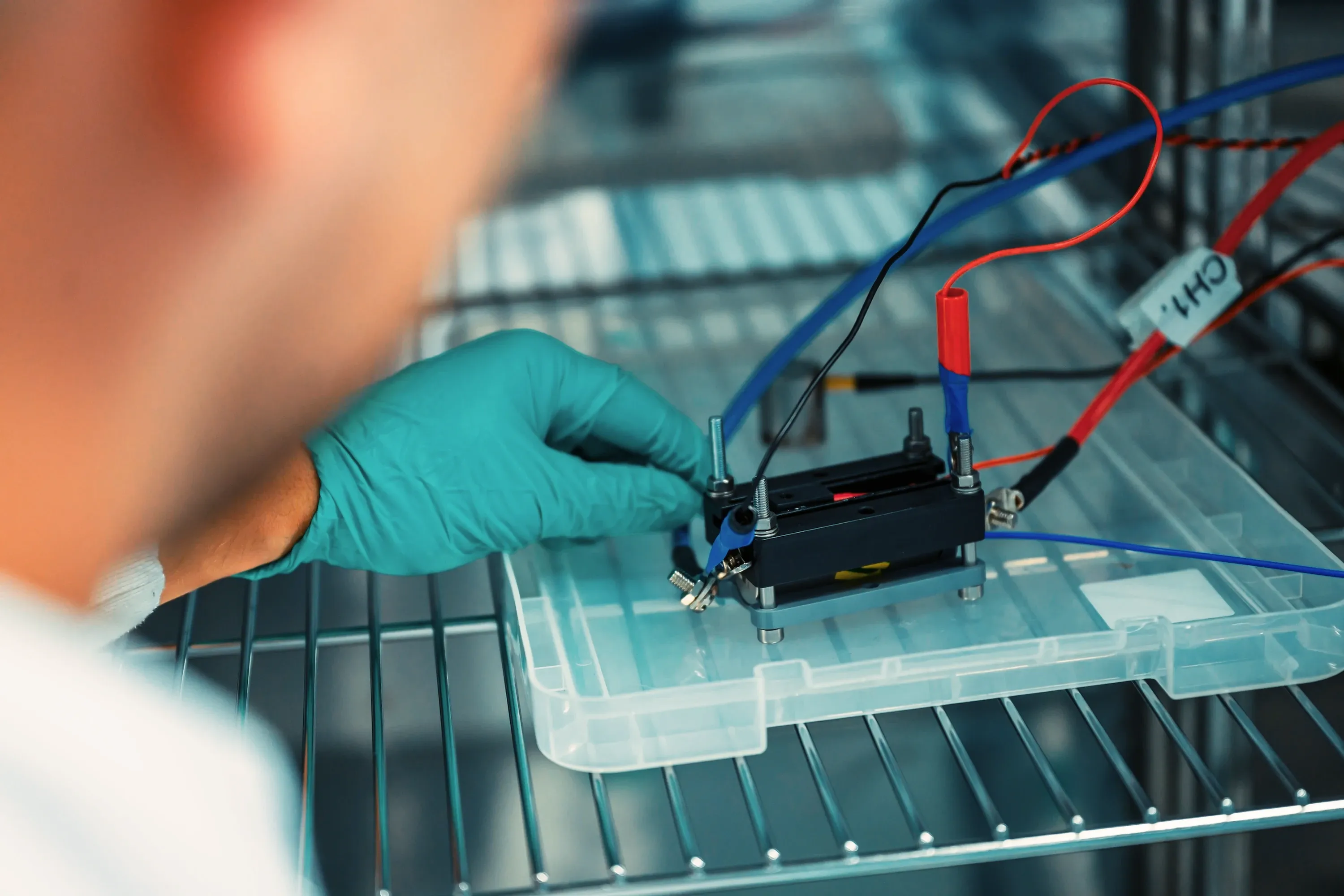
A passive sensor sits against the cell or the fixture that holds it; steady contact lets it pick up emissions from inside.
One hit
Illustration. A short burst crosses a dashed threshold line and the span above the threshold is highlighted as one acoustic hit. The span above the threshold is recorded as one hit.
A threshold, then a hit
Acoustic hits are captured automatically. Each time the signal crosses a set threshold, one hit is recorded.
Timeline
Illustration. Hits from the run appear as short bars along a time axis with timestamps, beneath a voltage curve recorded on the same clock. A few regular grey bars from operational noise sit among them. Acoustic data is collected as it happens.
Captured on the same clock
Hits are timestamped and, where the equipment allows, synchronised with the electrochemical and conventional data from your existing setup.
Noise separated
Illustration. The regular grey noise bars fade from the timeline, leaving the blue hits from the cell. A card notes that operational noise is characterised in the setup and separated. Operational noise characterised in the setup, then separated.
Noise, separated
Test rooms and production lines are not quiet. We characterise the operational noise in your setup so it can be separated from activity inside the cell.
Classify each hit. Then compare.
A single test can produce thousands of hits. Our AI classifies each one in real time by its signal characteristics, so a long stream of raw events becomes something you can count and compare across cells and conditions.
What classification is not
- A diagnosis. A class describes a signal, not a mechanism.
- A pass or fail. Nothing is sorted or rejected automatically.
- A control signal. The system observes the test. It does not change it.
Put every hit in context.
The classified hits are synchronised with your electrochemical data and process steps on one timeline. A burst of activity while the electrochemical data stays flat is a moment worth investigating, not a verdict: it shows where to look, and the synchronised record shows what was happening at that moment.
Configured around your setup.
There is no fixed kit. We choose sensors and fixtures for the cell format, the equipment it sits in and the question you're asking, and check contact and background noise before any measurement counts. The first runs, under your existing protocol, calibrate the analysis to your cell and setup and establish what normal looks like.
On your equipment
Sensors and fixtures fit to formation equipment, cyclers or test rigs.
Where the data lives
Analysis can run in the cloud, on your premises or at the edge, on request. Raw signals can stay on your site.
What you get
A synchronised record, the classified hits and findings on which cells differ and why, with what the data does and doesn't show stated plainly.
Questions we're usually asked.
Does it work with all battery chemistries?
Yes. AcouBatt monitors physical processes common across battery chemistries, including gas evolution, cracking and mechanical degradation. The system is calibrated for each chemistry and cell design.
Does it work with all battery types?
AcouBatt can be adapted to pouch, cylindrical and prismatic cells, with the sensor configuration tailored to the cell format and equipment.
How accurate is your AI in classifying these signals?
Our models are validated using labelled battery experiments and complementary electrochemical and physical measurements. Performance is then calibrated for each cell design, environment and target application.
Built on published research.
The method comes from published battery-acoustics research at UCL and elsewhere, covering formation, ageing and failure testing.
Read the researchWhat do you need to understand?
Tell us about your cell, process or test. We'll discuss whether acoustic-emission monitoring could help and what a demo or a first measurement would involve.
Tell us what you're trying to understand